 |
|
|
HOURS
|
Welcome to the New Museum of Cape May County web site! |
LOGIN | SIGN UP |
|
||
|

|
Heroic Medicine at Sea: Daniel Hughes’ Medical Diary & Recipe Book Aboard the U.S. Warship Ganges & Merchant Ship America
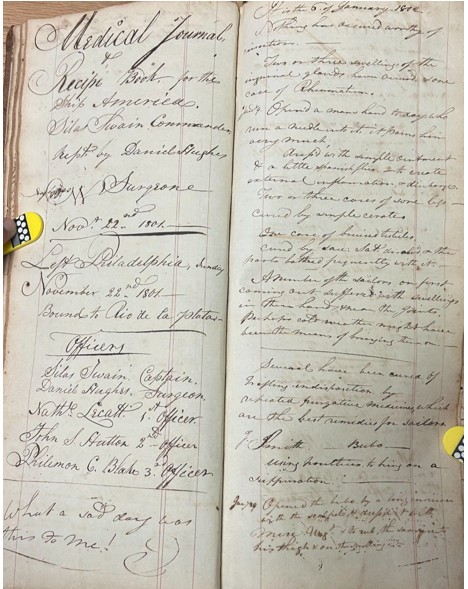
Heroic medicine was built on the idea that the body needed decisive intervention to recover from disease. Rather than waiting for symptoms to pass, physicians aimed to actively restore balance through procedures that directly altered the body. This included bloodletting, purging, sweating, and the use of some pretty strong medicinal compounds. Hughes’ journal reflects this mindset throughout. His entries move quickly from symptoms to action, documenting cases where fevers were met with repeating venesection, infections with chemical washes, and internal ailments with carefully measured doses of laudanum or mercury-based treatments. These responses weren’t improvised; they followed a widely accepted medical philosophy that prioritized intervention as the safest course in uncertain conditions.
Routine treatment log demonstrating repeated use of purgatives, blistering, and topical remedies from Daniel Hughes’ medical diary on merchant ship America. What makes Hughes’ diary especially compelling is how clearly it demonstrates the routine nature of heroic medicine. The same treatments appear across different cases, creating a rhythm in the entries that mirrors the structured thinking behind them. A sailor with swelling might receive topical applications to draw out irritation, while another with internal distress would be treated with purgatives to cleanse the system. Even when the conditions varied, the underlying approach remained consistent. This repetition reflects a broader confidence in the principles of heroic medicine, showing how deeply embedded these extreme practices were in everyday care. At sea, this approach carried particular weight. Unlike physicians on land, Hughes worked in an environment where options were limited and delays could be costly. The ship itself functioned as both workplace and living space, meaning that disease could affect the entire crew if not addressed quickly. In this context, heroic medicine offered a sense of control, a way to respond immediately and systematically to whatever conditions arose. Hughes’ careful recordkeeping suggests an ongoing effort to track symptoms, apply treatments, and observe outcomes within the constraints of shipboard life. The diary also offers brief but meaningful glimpses into the person behind the practice. While most entries are concise and clinical, moments like Hughes’ remark, “What a sad day was this to me!” remind us that these decisions weren’t made in an absence of emotion. They reflect the lived experience of a surgeon balancing medical responsibility with the realities of life at sea during the 18th century. Today, Hughes’ journal allows us to better understand how heroic medicine functioned in practice, not an abstract concept, but as a daily routine shaped by necessity and belief. The treatments recorded in it highlight how medical knowledge evolves, showing how approaches once considered essential can later be reconsidered as understanding grows. Rather than viewing these methods as simply outdated, the diary invites us to see them as part of a longer history of care, one defined by adaptation, experience, and the ongoing effort to respond to illness with the tools available. By preserving records like Hughes’ diary, the Museum of Cape May County offers a window into both maritime history and the development of medical practice. Hughes’ entries remind us that medicine has always been a balance between knowledge and uncertainty, shaped by the conditions in which it’s practiced and the people who carry it.
Preserving a Difficult History: Cape May Terrace and Racial Exclusion
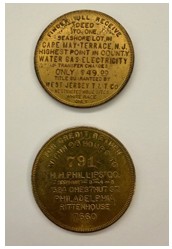
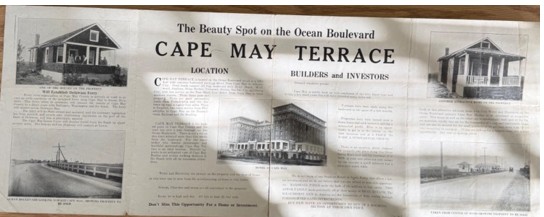
Photographs of a 1920s-era Cape May Terrace lot-deed token (left). The obverse reads, among other texts, “WHITE RACE ONLY”. Brochure for the failed Cape May Terrace neighborhood (right).
The Artifacts: Cape May Terrace Tokens and Town Brochure The items in question are brass-colored promotional tokens produced in the early 20th century to advertise real estate development in Cape May Terrace, New Jersey, and a brochure outlining the benefits of the expected community. This coin was issued by the H. H. Phillips Company of Philadelphia. One side of the tokens reads: "Finder will receive deeds to one seashore lot in Cape May Terrace, NJ, ... ONLY $49.00...restricted home sites, WHITE RACE ONLY". The reverse side reads: "For credit, return within 96 hours to H.H. Phillips Co., room 622-3-4-5-, 1524 Chestnut St., Philadelphia, Rittenhouse." used as promotional items in "pressure sales" style land developer schemes. (“Token - H. H. Phillips Co, United States”). The brochure advertises building lots with the name “Ocean Boulevard,” promising leisure and prosperity. Though the brochure never explicitly mentions race, developments like this were commonly envisioned as whites-only communities. The coin and brochure themselves are historic relics: material evidence of how housing and property were marketed during the redlining era of the early to mid 20th century. Historical Context During the late 19th and early 20th centuries, many American cities and suburbs enforced segregation through covenants and promotional materials. In New Jersey, many old housing deeds often contained racist covenants, legal clauses barring non-White residents, and Cape May was no exception. Optimum News 12 New Jersey noted that “racist covenants were common across New Jersey… from Cape May to Sussex County throughout the first half of the 20th century.” These Cape May Terrace artifacts reflect this practice precisely: they advertised that only White people could own lots in certain places. These are primary sources illustrating how racial exclusion was normalized in everyday life, even in something as small as a property sales promotional item. Why Preserve These Objects? Though the phrase “White Race Only” is clearly offensive, it is unfortunately an authentic piece of history. Removing or ignoring such objects would risk erasing history. By keeping them, we follow a practice similar to institutions like the “Jim Crow Museum of Racist Imagery” in Big Rapids, Michigan, which collects racist artifacts to educate the public about intolerance. As Jim Crow Museum founder David Pilgrim has emphasized, objects of hatred can be powerful teaching tools: their mission is “using objects of intolerance to teach tolerance and promote social justice” (Pilgrim). The Cape May Terrace artifacts belong in a collection where they can be studied and discussed, not to glorify racism, but to document and learn from it.
Connecting to Sociological Knowledge These artifacts are material examples of the sociological concepts of institutional racism and social stratification. Sociologists like Peggy McIntosh and others have shown that these items are entrenched in long-lasting inequalities. By studying them, we can look back at how racial categories were enforced by law and custom, shaping patterns of wealth, community development, and social status. The way I see it, these items serve to integrate analysis with social justice education. Many believe these items need to be destroyed, but doing so would erase a part of history that could soon be forgotten and replicated. By tying them to scholarship and academia, they lend weight to segregation studies by turning them into real, tangible history. |
|

|
||||||||||||||||||||||||||||||||||||
|
||||||||||||||||||||||||||||||||||||
 |
||||||||||||||||||||||||||||||||||||
| © The Museum of Cape May County - All Rights Reserved. 504 Route 9 North, Cape May Court House, NJ 08210 Admin | Web Site Designed By: Square 1 Design |
||||||||||||||||||||||||||||||||||||
|
||||||||||||||||||||||||||||||||||||


